


Square jaw botox in Suwon: how many weeks does it take for the jawline to change?

If a week has passed since your square jaw botox and you are worried because your jaw in the mirror looks the same, it helps to first understand the order in which changes appear. Square jaw botox is a treatment that injects botox into the chewing muscle (masseter) at the corner of the jaw below the ear to reduce muscle movement, so that the less-used muscle becomes smaller over several weeks.
Muscle mass begins to decrease gradually from 2 weeks after treatment, and changes in the jawline are checked over 1 to 2 months on average. It is not a treatment that makes the jaw smaller on the day of injection; the muscle's strength decreases first and its volume decreases later. At our Suwon clinic, during consultation we have you clench your teeth to first check the thickness and position of the masseter, any size difference between the two sides, and the shape of the jawbone, and then decide the dose and injection points.
In this article, we go through how square jaw botox slims the jaw, the changes over time, the treatment process, how long results last and aftercare, and side effects.
Key points about square jaw botox
- Square jaw botox works by blocking the contraction signal of the masseter to reduce its strength, after which the less-used muscle becomes smaller over several weeks.
- Muscle mass begins to decrease after 2 weeks, and changes in the jawline are checked over 1 to 2 months on average.
- The muscle returns to its original size over 6 to 8 months, and repeat injections are given at 4- to 5-month intervals as a guideline.
- If the angular look is caused by the shape of the jawbone rather than the muscle, the extent of reduction is small.
How does square jaw Botox reduce the jaw?
The masseter is a muscle that contracts strongly when you chew food or clench your teeth. If you often eat tough, hard foods or have a habit of clenching your teeth, this muscle thickens, and the lower face looks wide and angular from the front.
Botox blocks the contraction signal sent from nerve endings to the muscle, reducing the movement of the masseter. Just as muscles become thinner when you stop exercising, the masseter, now used with less force, also decreases in volume over several weeks. If you have a habit of grinding or clenching your teeth, the masseter is used day and night and the area around the jaw may feel stiff; in such cases, botox is also used to reduce the force the muscle exerts.
If the area below your ears bulges firmly when you clench your teeth tightly, muscle plays a large role; if there is little change even when you apply force and the corner of the bone protrudes, bone structure plays a large role. If your jaw looks angular because of the shape of the bone, the extent of reduction with jaw botox is small.
How do the effects of square jaw botox appear over time?
The table below divides the course commonly seen after treatment by period. The timing may shift earlier or later depending on muscle size and habits.
| Period | What happens in the muscle | Changes you may notice |
|---|---|---|
| On the day of treatment | The medication settles at the nerve endings of the masseter | No change in appearance yet |
| A few days later | The contraction signal begins to decrease | Chewing takes less force, or the jaw feels stiff |
| Around 2 weeks | The volume of the less-used muscle begins to decrease | Compare the height of the muscle that bulges when you clench your teeth |
| 1–2 months | The decrease in volume continues | Check changes in the jawline in front-view photos |
| 6 to 8 months | The muscle is used again and returns to its original size | Chewing strength returns and volume gradually increases |
When you first check around 2 weeks, comparing the height of the muscle under your fingers when you clench your teeth is more accurate than looking in the mirror. Facial photos must be taken under the same lighting and angle to compare the change.
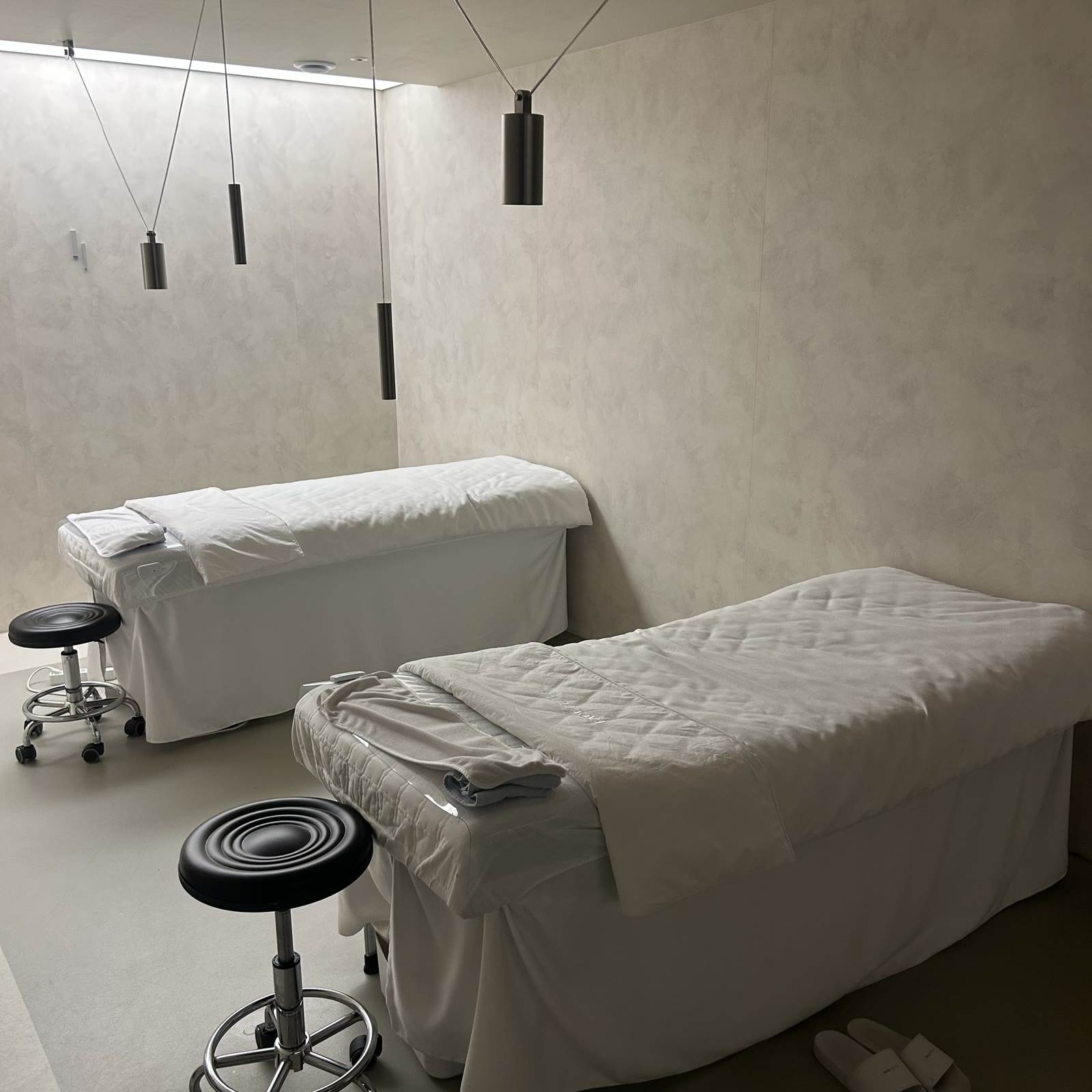
How is square jaw botox performed?
How we determine the dose and injection points
The masseter differs from person to person in thickness, position, and size on each side, so we have you clench your teeth, check by hand where it bulges most thickly, and decide the injection points. In faces with little cheek fat, the area below the cheekbones may look hollow as masseter volume decreases, so we also look at the amount of cheek fat. Repeating large doses at short intervals can lead to antibodies that neutralize the medication, so for repeat injections we also discuss low-resistance products.
Treatment steps at our Suwon clinic
- Personalized Consultation
- Design
- Disinfection
- Treatment
The treatment is done in about 10 minutes, and you can return to daily life right away. The basic package is 50 units, and the product is chosen from domestic, domestic low-resistance, and German low-resistance options based on your treatment history and frequency. If the salivary glands are large and the lower side contour of the jaw looks thick, we also discuss salivary gland botox.
View masseter Botox treatment information
Recovery and maintenance after square jaw botox
- You can wash your face and wear makeup starting 2-3 hours after treatment.
- For 3–7 days after treatment, avoid heavy drinking, smoking, saunas and jjimjilbang, hot baths, and strenuous exercise to prevent inflammation.
- Do not rub the treated area hard, and avoid strong massages or meridian massage for one month.
- Tough or hard foods can shorten how long the results last and cause pain, so avoid them as much as possible.
Although it varies with muscle mass and lifestyle habits, the muscle returns to its original size over 6 to 8 months, so to maintain the change, repeat injections are given at 4- to 5-month intervals as a guideline. The timing of the next treatment is decided not only by the date but also by feeling how much the muscle has returned when you clench your teeth. Cutting back on foods that require long chewing, such as gum or dried squid, and getting into the habit of chewing evenly with the molars on both sides may help.
Side effects and precautions for square jaw botox
Common reactions are small bruises and swelling at the injection sites, which appear mildly and subside soon. For a while after treatment, your jaw may feel stiff when chewing or it may be hard to chew hard foods for a long time; this is a temporary change that occurs as muscle strength decreases.
In rare cases, if the medication spreads to surrounding muscles, the corners of the mouth may become asymmetrical when you smile, and in faces with little cheek fat the area below the cheekbones may look hollow. Pressing or rubbing the area hard right after treatment increases the risk of spreading, and effects and reactions vary from person to person depending on muscle size and lifestyle habits. Please let us know before treatment if you are pregnant or breastfeeding, have a neuromuscular disease, or have ever had a hypersensitivity reaction to botulinum toxin.
If one corner of your mouth does not rise when you smile, if chewing and swallowing are uncomfortable enough to interfere with daily life, or if the injection sites become increasingly swollen and warm, please contact the clinic right away.
What do we check before square jaw botox?
In these cases, start by having your masseter checked
- When I clench my teeth tightly, the area below my ears bulges firmly.
- I enjoy tough or hard foods and tend to chew on one side.
- My jaw feels stiff when I wake up, or I have been told that I grind my teeth.
- From the front, my lower face looks wider than the upper part of my face.
If two or more of these apply, it is best to first check before treatment whether the angular look comes from the muscle or the jawbone. Whether to proceed, the dose, and the injection points are decided together during consultation after an examination by our medical staff.
In short, with square jaw botox the muscle begins to shrink after 2 weeks and changes are checked over 1 to 2 months, so the key is to observe according to this timeline and maintain results at 4- to 5-month intervals.
FAQ
Q. When will I see the effect of square jaw Botox?
A. The feeling of reduced chewing strength comes after a few days, and muscle mass begins to decrease gradually from 2 weeks after treatment. Changes in the jawline are checked over 1 to 2 months on average, and the timing may shift earlier or later depending on muscle size and habits.
Q. If there is no change after a week, does that mean it didn't work?
A. One week is when muscle strength has just begun to decrease, so changes in appearance may still be small. After 2 weeks, compare the height of the muscle again when you clench your teeth, and if there is still little change after 1 to 2 months, we check the condition of the muscle through an examination.
Q. How long does square jaw Botox last?
A. The muscle gradually returns to its original size over 6 to 8 months. If you have a strong habit of clenching your teeth or often eat tough foods, the muscle is used again sooner and the duration may be shorter, and how long results last varies from person to person.
Q. How is the square jaw Botox cycle planned?
A. To maintain the change, repeat injections are given at 4- to 5-month intervals as a guideline. The timing is decided by feeling how much the muscle has returned when you clench your teeth, and it is best to avoid repeating large doses at short intervals.
Q. Can jaw botox help if my jawbone is angular?
A. Botox is a treatment that reduces muscle volume, so if the angular look is caused by the shape of the bone, the extent of reduction is small. During consultation, we have you clench your teeth to first check whether muscle or bone plays the larger role, and then decide whether to proceed and the method.
Q. How can I find out the cost of square jaw botox?
A. The cost depends on the dose and the type of product. We provide the details after confirming during consultation whether a domestic or low-resistance product will be used and whether salivary gland botox will be added, and you can also check the items on the treatment information page.
This content is provided as general treatment information and is not a substitute for diagnosis or treatment. Always consult a medical professional to decide whether and how to proceed with a treatment.