


Flat wart removal in Suwon: how do you tell them apart from moles, and how are they removed?
If flat, skin-colored bumps on your forehead or cheeks are gradually increasing and bothering you, it is worth checking for flat warts before assuming they are moles. Flat warts are viral warts that develop when the human papillomavirus (HPV) enters the skin through tiny cuts, and they appear as clusters of flat, smooth bumps 1–3 mm in size.
Flat wart removal involves using a CO2 laser to shave away each visible lesion in thin layers, then managing the skin during recovery so the virus does not spread to the surrounding area again. At our Suwon clinic, we first look at the shape and distribution of the lesions during the consultation, and if they are mixed with moles or other lesions, we sort out which ones to treat with the laser before deciding on the treatment area.
In this article, we go over why flat warts appear and spread, how to tell them apart from moles and closed comedones, the laser removal process, recovery and recurrence care, and side effects, in that order.
Flat warts: key points
- They are caused by human papillomavirus infection and spread along areas that have been scratched or shaved.
- Moles stay in one place, while flat warts increase in number or form in lines.
- Each lesion is vaporized with a CO2 laser, and lesions that surface later are treated again at intervals of 1–3 months.
- Red marks after treatment are part of the healing process and fade over 1–2 months.
Why do flat warts appear, and why do they spread?
Flat warts are caused by human papillomavirus infection. When the virus enters cells in the outer layer of the skin and increases cell division, small bumps with flat surfaces form. They tend to appear on the forehead, cheeks, chin, and around the mouth, areas that are often touched and irritated by shaving or face washing.
They spread because of infection as well. If you scratch because of itching, new lesions form in a line along the path of your fingernail, and if a razor or hair removal tool brushes against a lesion, the virus moves to the surrounding skin. During periods of accumulated fatigue or lowered immunity, the number can suddenly increase.
Some disappear on their own over time, but this often takes months to years, and the affected area can widen in the meantime. Getting a diagnosis while there are only a few makes it easier to plan treatment, since fewer lesions need to be treated at once.
How do you tell flat warts apart from moles and closed comedones?
Because they are easy to confuse by appearance alone, we look at the cause, shape, distribution, and what happens when you try to squeeze them. The table below shows the criteria commonly compared during consultations.
| Category | Flat warts | mole | Closed comedones and milia |
|---|---|---|---|
| Cause | Viral infection | A cluster of melanocytes | Trapped sebum or dead skin cells |
| Shape and color | Flat, smooth bumps that are skin-colored or light brown | Brown to black, with a well-defined border | Raised and white or red |
| Distribution | Several cluster together or form in a line along a scratch | Stays in one place | Scattered here and there |
| When squeezed | Nothing comes out | Nothing comes out | Sebum or grains of dead skin may come out |
If a mole changes in shape, color, or size over a short period, or has jagged borders, we do not remove it right away with a laser but first determine whether a biopsy is needed. Bumps that look like warts follow the same steps if they show such changes.
How is flat wart removal performed?
How CO2 laser removal works
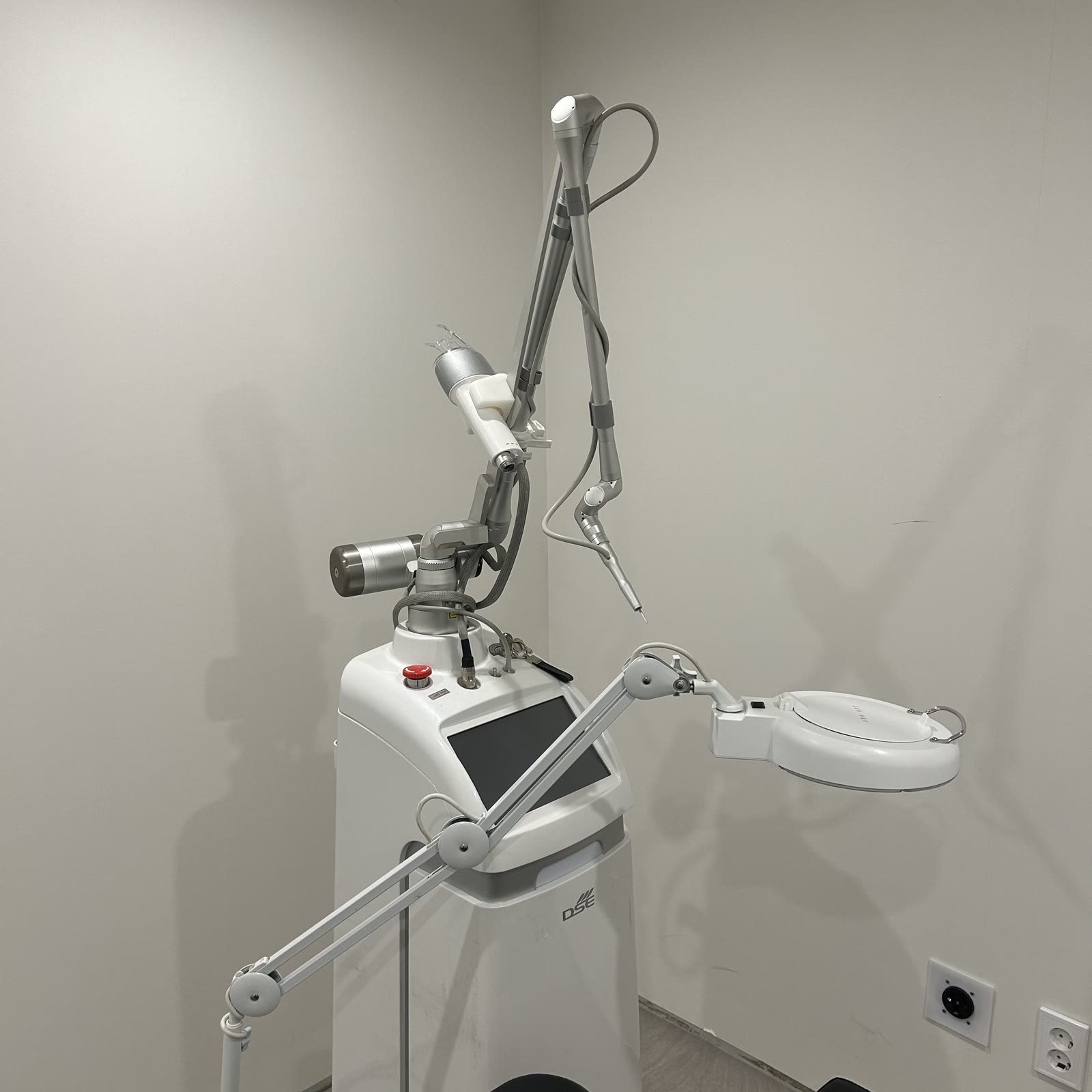
When several small, shallow lesions are scattered across the face, a CO2 laser is mainly used. A CO2 laser uses the property of 10,600 nm light being absorbed by water in the skin to vaporize lesion tissue and shave it away in thin layers. Since each lesion differs in depth and size, the power and exposure time are adjusted one by one, with the goal of leaving the surrounding normal skin as untouched as possible.
Cryotherapy and topical medications are also used to treat warts. The method depends on whether the lesions are thick, like those on the hands and feet, or shallow and scattered, like those on the face, and if sensitive areas such as around the eyes are included, treatment is divided into several sessions.
Treatment steps at our Suwon clinic
- Personalized Consultation
- Photos (Before Treatment)
- Numbing Cream
- Treatment
- Photos (After Treatment)
- Finishing Care
Anesthesia is done with a numbing cream, and the procedure takes about an hour or less, depending on the number and extent of lesions. The treatment area is divided into the whole face and the whole neck, each in tiers of up to 50, up to 100, and over 100 lesions, and lesions on the body are set separately for the front and back. When treating again, we wait 1–3 months until the previous areas have fully healed.
View CO2 laser mole and flat wart removal details
Recovery and recurrence care after flat wart removal
- Don't pick at the scab by hand — let it fall off on its own.
- Red marks where the scabs have fallen off are a reaction that occurs during healing and fade over 1–2 months.
- For 3–7 days after treatment, avoid heavy drinking, smoking, saunas and jjimjilbang, hot baths, and strenuous exercise to prevent inflammation.
- Depending on the treated area, medication is prescribed to prevent inflammation and relieve pain; take it for 3 days without missing a dose.
- During recovery, apply sunscreen every time you go out to reduce pigmentation.
Because the cause is a virus, even after visible lesions are removed, virus hiding in the surrounding skin can form new lesions. Using a separate razor and towel and not touching your face often may help reduce the chance of it spreading again. If you notice new bumps in the weeks after treatment, please let us know at your next visit.
Side effects and precautions for flat wart laser treatment
Right after treatment, redness, stinging, and small scabs appear, and most of these are reactions that occur during healing. After the scabs fall off, red or light brown marks may remain for a while, and recovery speed and results vary from person to person.
In rare cases, depressed scars, long-lasting pigmentation, or inflammation can occur. Forcibly picking off scabs or getting a lot of UV exposure during recovery increases these risks, and people prone to keloids, where wounds heal thick, are also at higher risk. If you have a medical history such as an antibiotic allergy or any special conditions, be sure to tell us before treatment. If you are pregnant or taking medication that makes you sensitive to light, please let us know before treatment.
If the treated area becomes increasingly swollen and painful, pus comes out, or warmth does not subside for several days, these may be signs of inflammation, so please contact the clinic right away.
What should be checked before flat wart removal?
If any of these apply, get a diagnosis first
- Flat bumps on my face have increased over a few months.
- Bumps have formed in a line along areas I scratched or shaved.
- They are skin-colored or light brown bumps that release nothing when squeezed.
- Something I thought was a mole has recently changed in shape or color.
If two or more apply, it is a good idea to confirm what type of lesion it is before laser treatment. Whether to treat, which method to use, and the treatment area are decided together during the consultation after the doctor's examination.
In short, the key with flat warts is to get a diagnosis while there are only a few and to manage them after treatment so they do not spread again.
FAQ
Q. Can flat warts spread to other people?
A. Because the cause is a virus, it can spread to other people through direct skin contact or by sharing razors and towels. During treatment, it is best to use your own personal items and avoid touching other parts of your face with hands that have touched the lesions.
Q. Will flat warts go away if left alone?
A. They sometimes disappear on their own, but this can take months to years, and in the meantime they can increase in number along areas you scratch or shave. If new bumps keep appearing, we recommend getting a diagnosis first before the area widens.
Q. Does laser removal of flat warts hurt?
A. A numbing cream is applied to the treatment area and given enough time to work before the procedure, which reduces the stinging sensation. How much you feel depends on the area, the number of lesions, and the individual, and thin-skinned areas such as around the eyes or mouth may feel a little more sensitive.
Q. Can flat warts all be removed in one session?
A. Visible lesions are treated in one session, but if lesions hidden in the skin surface later, additional treatment may be needed. For a follow-up session, we wait 1–3 months until the previously treated areas have fully healed and then check the remaining lesions.
Q. When can I start washing my face and wearing makeup after treatment?
A. Until the scabs fall off, do not rub the treated area and wash gently with lukewarm water. When you can resume makeup depends on the treatment area and how quickly the scabs come off, so we give area-specific instructions after the procedure.
Q. How can I find out the cost of flat wart removal?
A. The cost depends on the number of lesions and the treatment area. We confirm during the consultation how many lesions on the face, neck, or body will be treated before giving you the details, and you can also check the items for each treatment area on our treatment information page.
This content is provided as general treatment information and is not a substitute for diagnosis or treatment. Always consult a medical professional to decide whether and how to proceed with a treatment.