


C-Section Scar Laser in Suwon: When Should It Start and How Is It Treated?
If your C-section scar on the lower abdomen has become raised and red, itchy, or hard after giving birth and it bothers you, it is worth first checking what stage the scar is at now. A C-section scar is a surgical scar running across the lower abdomen, and since it is pulled every time you move, it tends to become red and thick.
With surgical scar lasers, it is easier to guide the direction while the skin is still healing than after the scar has fully hardened. Once the stitches are removed, the wound has closed, and oozing and scabs are gone, vascular lasers for redness are considered first, and Fraxel, which makes microscopic holes in the skin, follows after the wound has firmly healed. At our Suwon clinic, we first look at the color and height of the scar and how long it has been healed during the consultation, and then decide on the device and when to start.
This article walks through how surgical scars settle, how to tell hypertrophic scars, keloids, and depressed scars apart, how lasers work and the treatment process, recovery and home care, and side effects.
Key Points on C-Section Scars
- After surgery, the skin continues to regenerate internally for several months up to 1 to 2 years, and it is during this period that it is determined whether the scar will rise or widen.
- Hypertrophic scars rise within the boundaries of the wound, while keloids spread into normal skin beyond the original wound.
- Red scars are treated with vascular lasers, and hard, rough scars with lasers that promote regeneration, such as CO2 Fraxel.
- CO2 Fraxel is generally planned as 3 to 5 or more sessions at one-month intervals, and you can wash your face starting the day after treatment.
How do C-section scars settle?
A wound goes through an inflammatory phase, a phase in which new tissue and blood vessels fill in, and a phase in which the new tissue is firmly reorganized, in that order. Around the time the stitches are removed, new tissue is filling in, so many fine blood vessels form inside the scar and make it look red; if blood vessels and collagen increase excessively during this phase, the scar becomes raised.
The first few months after surgery are when the severed skin regains its strength, so if both sides of the wound keep being pulled, the scar widens sideways. Scars that run across the lower abdomen like C-section scars, scars pulled with every neck movement like thyroid surgery scars, and breast surgery scars are in areas with a lot of movement and tension, so they tend to become red and thick.
Watching which direction the scar's color and height are heading during this period makes it easier to decide when to start what. Rather than waiting until the scar has fully hardened, it is better to get examined when redness lingers or the scar starts to rise.
How can hypertrophic scars, keloids, and depressed scars be told apart?
| Category | Hypertrophic scar | Keloid | Depressed scars |
|---|---|---|---|
| Shape | Rises red and thick following the shape of the wound | Grows sideways beyond the original wound | Sunken in |
| Extent | Does not extend beyond the original wound | Spreads into normal skin | Where inflammation or a wound used to be |
| Course | May gradually subside over several months | May grow back even after treatment | Hard to fill in on its own |
What people commonly call raised scar tissue is mostly hypertrophic scars or keloids. Although the two may look similar, they differ in how often they recur and how intensive treatment needs to be, so we first check whether the scar is growing beyond the boundaries of the wound. Areas where inflammation damaged the dermis, such as from chickenpox, shingles, or acne, are left with less collagen and become depressed scars, and for burn scars that pull over a wide area, we check during the examination whether other procedures are needed before lasers.
How is laser treatment for C-section scars performed?
How Scar Lasers Work
For red scars, we use vascular lasers that act on the dilated blood vessels inside the scar. At our Suwon clinic, this is done with Excel V Plus, which is used to reduce redness and help keep the scar from rising further. For raised scars, injecting medication into the scar to reduce its thickness is used alongside, and because keloids recur often, they are managed long-term with a combination of injections, lasers, compression, and silicone sheets.
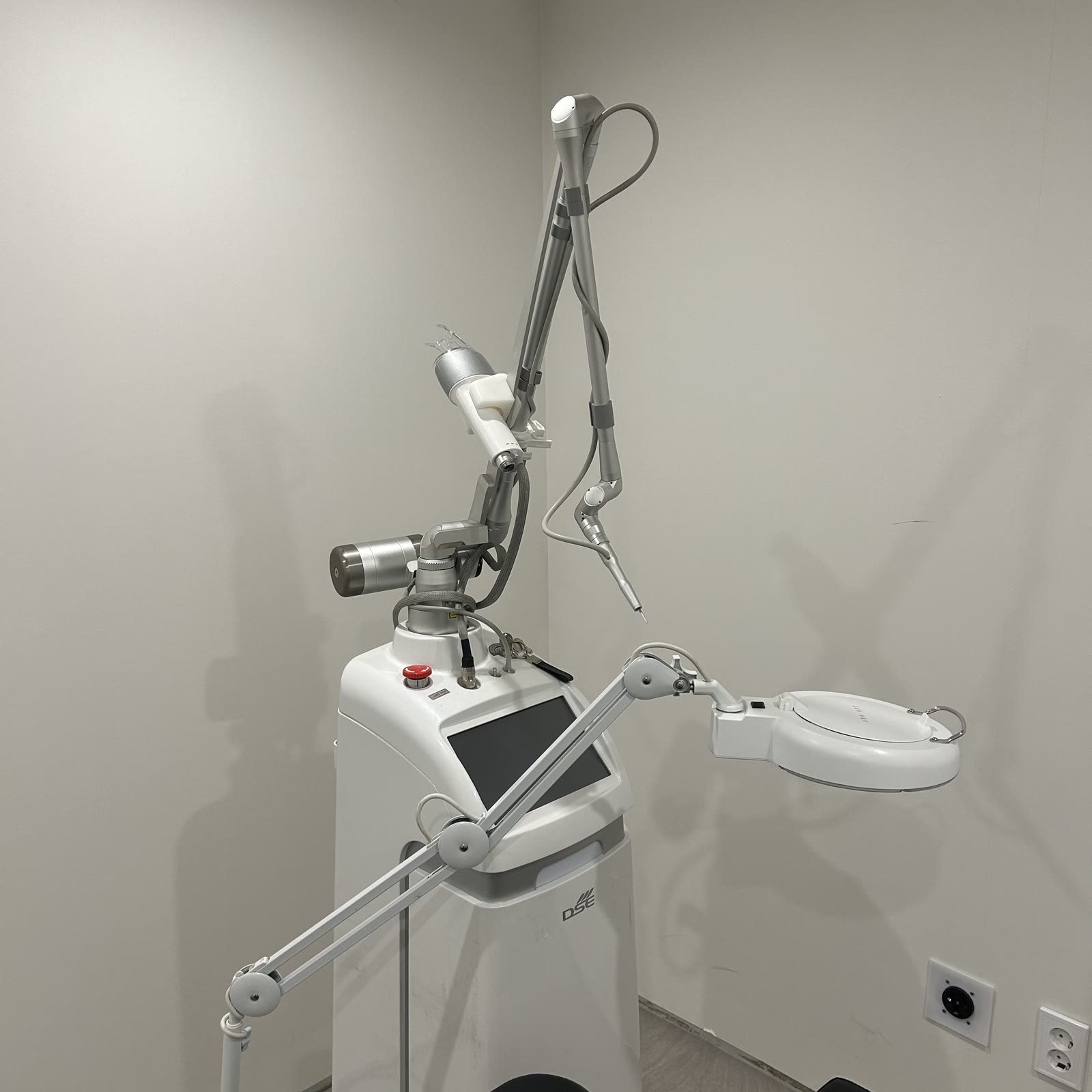
For hard, rough scars and depressed scars, we use CO2 Fraxel. It makes microscopic holes in the skin with thousands of laser beams to deliver energy down to the dermis, guiding the damaged tissue to reorganize and regenerate. Over the sessions, we look for changes toward the scar's surface roughness and height becoming closer to the surrounding skin.
Treatment steps at our Suwon clinic
- Personalized Consultation
- Self-Cleansing
- Numbing Cream
- Treatment
- Finishing Care
CO2 Fraxel is performed after topical anesthesia. Because results and how long they last vary with skin condition, sessions are generally planned as at least 3 to 5 or more at one-month intervals, with 1-session and 5-session options. For scars with remaining redness, Excel V Plus may be performed first at 3- to 4-week intervals, and when scar conditions are mixed, the redness is addressed first and the surface roughness afterward. Scar filler to fill depressed areas is decided after consultation based on the shape of the scar.
View CO2 Fraxel Treatment Information
See Excel V Plus treatment details
Recovery and Care After C-Section Scar Laser
- After CO2 Fraxel, you can wash your face starting the day after treatment.
- For 3–7 days after treatment, avoid heavy drinking, smoking, saunas and jjimjilbang, hot baths, and strenuous exercise to prevent inflammation.
- If fine flaking appears, let it fall off on its own; do not peel it off by hand or use scrub products.
- Because dryness occurs, apply moisturizer often, and apply sunscreen when you go out.
- Take a short break from anti-wrinkle cosmetics containing retinol and from brightening functional cosmetics.
At home, once the stitches are removed and there is no oozing, keep the scar moist with scar ointment or silicone sheets, secure it with tape so the wound does not spread open, and reduce movements that stretch the scar. New skin tans easily in the sun, so cover the scar with clothing or sunscreen. Because scars change over several months, taking photos under the same lighting helps when deciding on the next session.
Side Effects and Precautions for C-Section Scar Lasers
After laser treatment, warmth, tingling, swelling, redness, dryness, and itching may occur and soon subside. After vascular lasers, the treated area may swell temporarily, and after Fraxel, fine flaking and small scabs may continue for a few days. How much the scar fades and how fast it recovers vary from person to person depending on the scar condition and constitution.
Rarely, hyperpigmentation, loss of pigment, or blisters can occur, and after scar injections, the surrounding skin may thin or look sunken. People prone to keloids have a higher risk of scars growing back in areas that receive irritation, and peeling off fine flakes or getting a lot of sun during recovery increases the risk of pigment changes. If you are pregnant or breastfeeding, or are prone to keloids, please let us know before treatment.
If oozing or pus develops after treatment, or if pain and swelling do not ease and keep getting worse, please contact the clinic.
What should be checked before laser treatment for C-section scars?
If This Sounds Like You, Start with a Scar Examination
- It has been months since my stitches were removed, but the scar is still red.
- The scar is itchy and rising and becoming hard.
- The scar is spreading sideways beyond the original wound.
- I have had keloids on my ears, chest, or shoulders before.
If two or more of these apply, it is best to first check the type of scar and how well it has healed before starting laser treatment. Whether to have treatment, which method to use, and how wide an area to cover are decided together in consultation after the medical team examines you.
In short, the key with C-section scars is to check the color and height before the scar hardens, address the redness and the surface in order, and continue care at home.
FAQ
Q. When can I start laser treatment for a C-section scar?
A. Once the stitches are removed, the wound has closed, and oozing and scabs are gone, we first consider vascular lasers to address redness. For Fraxel, which makes microscopic holes in the skin, we check the scar through an examination after the wound has firmly healed and then decide the timing.
Q. If my C-section scar becomes raised and red, is it a keloid?
A. If it is raised following the shape of the wound, it is often a hypertrophic scar, and if it spreads into normal skin beyond the original wound, we suspect a keloid. The two differ in how intensive treatment needs to be and how often they recur, so we first tell them apart through an examination before deciding on treatment.
Q. Is applying scar ointment enough?
A. Ointments and silicone sheets are basic care that keeps the scar moist and supports healing. For scars that stay red for a long time or become thick and raised, ointment alone has its limits, so we look at the scar and consider lasers or injections as well.
Q. Can chickenpox or shingles scars be treated too?
A. Chickenpox and shingles scars are mostly depressed scars, so we proceed with sessions of lasers that promote dermal regeneration, such as CO2 Fraxel, and combine other treatments if needed. The number of sessions needed depends on the depth and shape of the scars.
Q. Can I get laser treatment for an old C-section scar?
A. Even scars that are several years old can be treated with lasers that refine surface roughness and height differences, but they may need more sessions than early scars. We check the scar's thickness, color, and degree of tightness through an examination and then decide on the device and number of sessions.
Q. How can I find out the cost of laser treatment for C-section scars?
A. The cost depends on the size of the scar, the device used, and the number of sessions. We check the scar during the consultation, including whether to start with vascular lasers and how many Fraxel sessions to do, and then explain the cost. You can also check the items on our treatment information page.
This content is provided as general treatment information and is not a substitute for diagnosis or treatment. Always consult a medical professional to decide whether and how to proceed with a treatment.