


Brazilian laser hair removal in Suwon: why does it take more sessions and longer intervals?
If repeated waxing or shaving has left your skin red and caused ingrown hairs, it is worth first learning how lasers reduce hair, as well as how many sessions you need and at what intervals. Brazilian laser hair removal is a treatment that uses a laser to reduce hair from the bikini line to the perineum and around the anus.
In this area the hair is thick and deeply rooted while the skin is thin and dark, making it hard to deliver strong energy in one go, and body hair has a longer resting phase than facial hair, so the number of sessions and the intervals are longer than for other areas. The number of sessions and intervals needed vary depending on the area and each person's hair condition. At our Suwon clinic, during consultation we first look at the area you want treated, hair thickness, density, skin color, and whether you have tanned recently, and then decide the wavelength and energy.
In this article, we go through why laser hair removal requires multiple sessions, why the number of sessions and intervals are longer for the Brazilian area and the differences by coverage area, the treatment process, before-and-after care, and side effects.
Key points about Brazilian laser hair removal
- The laser is absorbed by the melanin of hair in the growth phase and transfers heat to the hair follicle, so multiple sessions are done in line with the hair growth cycle.
- Because of thick, deep hair, thin and dark skin, and a long resting phase, the number of sessions and intervals are longer than for other areas.
- The coverage is set by dividing it into the bikini line, semi-Brazilian, and a range that includes the perineum and anus.
- Avoid waxing and tweezing that pull hair out by the root, as well as tanning, starting 4 to 6 weeks before treatment, and trim hair by shaving only.
Why does laser hair removal require multiple sessions?
The laser is absorbed by the black pigment (melanin) in the hair and converted into heat, and this heat is transferred to the follicle around the hair root, weakening the hair's ability to grow back. The period when the hair root and hair are attached and full of pigment is the growth phase, so the hairs on which the laser works properly are also those in the growth phase.
Hair grows through the growth, regression, and resting phases, and only some of the hair is in the growth phase at any given time. That is why after one session we wait for the resting hairs to enter the growth phase and then treat again, repeating this process.
Why does Brazilian laser hair removal take more sessions and longer intervals?
The hair and skin in the Brazilian area have different characteristics from those on the face or limbs, so even with the same laser, the treatment approach differs. The table below summarizes those differences.
| Category | Brazilian area | Face and limbs |
|---|---|---|
| Hair thickness and depth | Thick, deep-rooted, and dense | Relatively fine and shallow |
| Skin | Thin and tends to be darker due to friction | Varies by area |
| Energy adjustment | Lowered and divided into multiple passes because the skin also absorbs light | Adjusted while watching the skin's response |
| Resting phase | Long resting phase because it is body hair | Relatively short for facial hair |
Because this area is influenced by hormones, some fine hair may grow back even after completing the sessions, and it is hard to expect all hair to disappear at once. The coverage area also makes a difference. Bikini line hair removal tidies only the edge hair visible outside underwear, semi-Brazilian leaves some hair in front, and full Brazilian includes the perineum and the area around the anus. The wider the area, the more thin and dark skin is included, so output adjustment becomes more precise.
How is Brazilian hair removal performed?
How two wavelengths are matched to hair and skin color
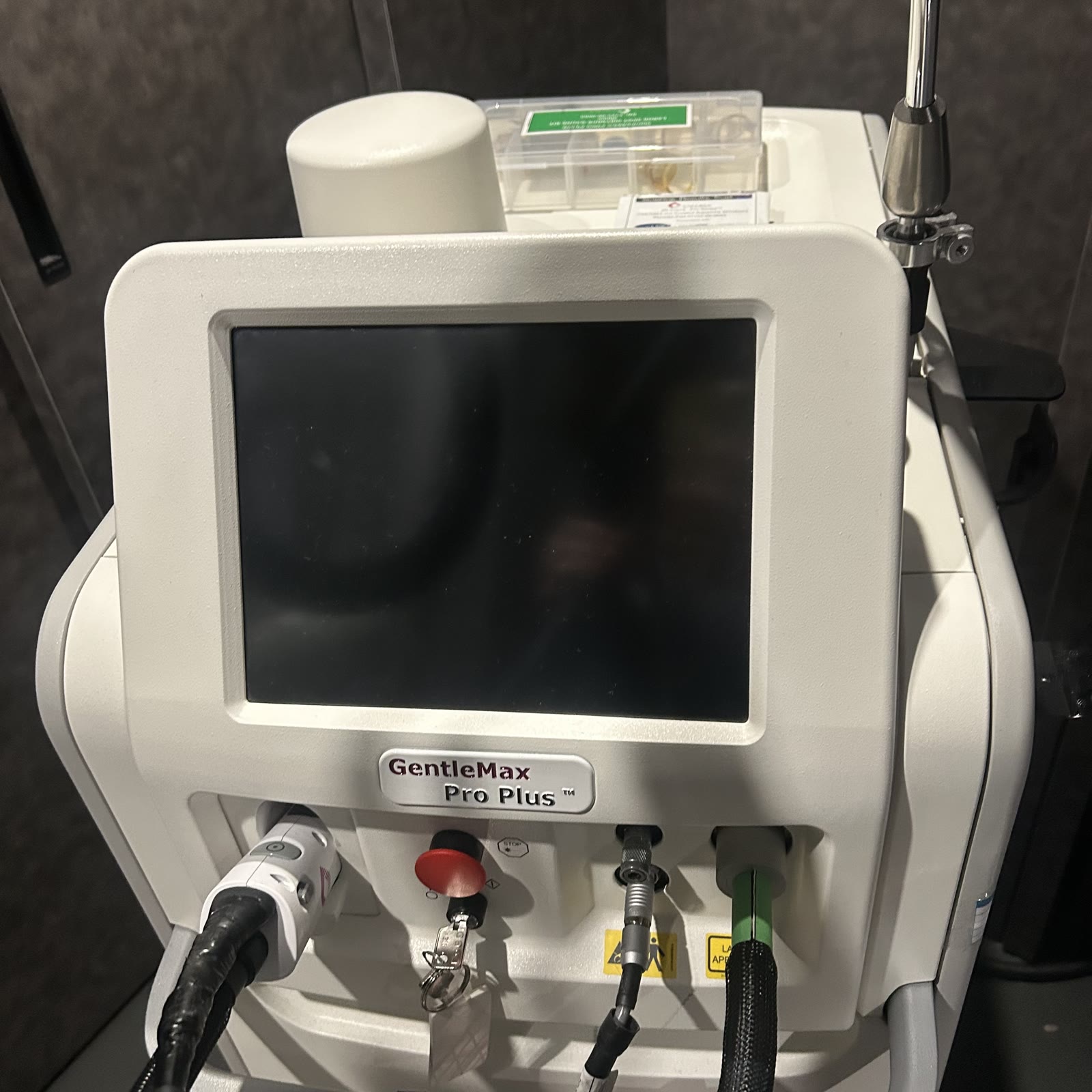
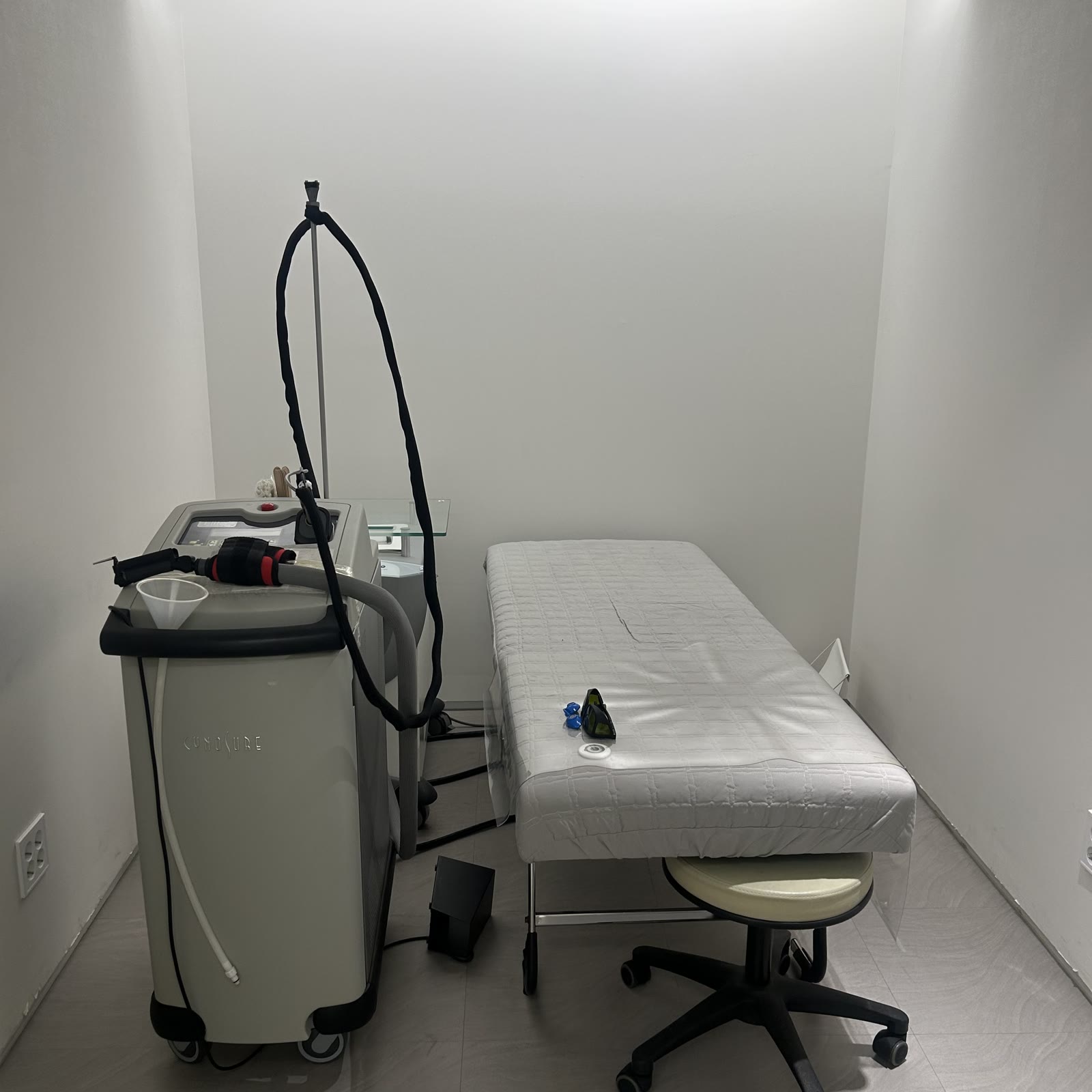
Both the GentleMax Pro Plus and the Apogee Elite Plus at our Suwon clinic use two wavelengths: 755nm alexandrite and 1064nm Nd:YAG. The 755nm wavelength is well absorbed by melanin, so it is chosen for dark, thick hair, while 1064nm penetrates deeper and is absorbed less by pigment on the skin surface, so it is chosen for areas with darker skin. The GentleMax Pro Plus has a cooling device (DCD) that cools the epidermis the moment the laser fires, reducing pain during treatment.
Treatment steps at our Suwon clinic
- Personalized Consultation
- Preparing the treatment area and checking the shave
- Wearing protective eyewear
- Laser application
- Cooling and soothing care
For women, the coverage is divided into the bikini line, semi-Brazilian, and Brazilian plus the perineum, anus, and buttocks, in units of 5 sessions; for men, the bikini line, Brazilian, perineum, and anus coverage is set in units of 5 sessions. As sessions accumulate and fewer new hairs come in, the interval is set based on how quickly hair grows back, and with any package, the energy is adjusted while watching the skin's response.
See women's body hair removal details
Care before and after Brazilian laser hair removal
- Avoid methods that pull hair out by the root, such as waxing and tweezing, as well as sunbathing and strong sun exposure, starting 4 to 6 weeks before treatment, and trim hair by shaving only.
- On the day of treatment, do not rub the treated area hard or exfoliate, avoid hot showers, and moisturize well.
- The skin becomes sensitive after treatment, so apply sunscreen to exposed areas when you go out and avoid prolonged direct sunlight.
- Tight underwear and pants irritate the hair follicles through friction, so wear breathable clothing for a few days.
Hair treated with the laser does not fall out right away but is pushed out and sheds over time, so it may look as if it is growing back. Even during this period, do not pluck the hair; trim it by shaving only, so that hair remains for the laser to act on in the next session.
Side effects and precautions for Brazilian laser hair removal
Common reactions are redness and swelling around the hair openings, a feeling of heat, and stinging, which subside over time. Because the area is moist and subject to a lot of friction, folliculitis resembling small pimples may form at the hair openings after a few days, and the degree of reaction varies from person to person depending on hair thickness and skin color.
In rare cases, blisters, burns, or pigment changes in which the treated area becomes darker or lighter may occur. The risk increases if your skin is dark, you have tanned recently, or heat is repeatedly applied to the same spot, so if you have recently had strong sun exposure or tanned, please be sure to tell us before treatment. Please also let us know in advance if you are taking oral acne medication or medication that makes you sensitive to light, or if you have herpes or wounds in the treatment area.
If blisters form, if redness, swelling, and pain do not ease and keep getting worse, or if pus-filled bumps spread, do not pop them; please contact the clinic as soon as possible.
What do we check before Brazilian hair removal?
In these cases, start by having your skin and hair condition checked
- I often get red bumps and itching after shaving or waxing.
- I keep getting ingrown hairs that grow under the skin.
- I have tanned or gotten a lot of sun in the past month or two.
- I have not yet decided how far to go between the bikini line and Brazilian.
If two or more of these apply, it is best to first check your skin color, hair condition, and the coverage you want before treatment. Whether to proceed, the coverage, and the energy are decided together during consultation after an examination by our medical staff.
In short, the key to Brazilian laser hair removal is to continue sessions in line with the hair growth cycle and protect your skin by avoiding waxing and tanning before and after treatment.
FAQ
Q. How many sessions of Brazilian laser hair removal do I need?
A. We start in units of 5 sessions, and if the hair is thick and dense, we add sessions while monitoring how much the hair decreases. Because this area is influenced by hormones, some fine hair may grow back even after completing the sessions, so the number of sessions needed varies from person to person.
Q. How are intervals for Brazilian hair removal set?
A. We have to wait for resting hairs to re-enter the growth phase, so intervals tend to be set wider than for the face. As sessions accumulate and fewer new hairs grow, we decide the timing of the next treatment together during consultation based on how quickly hair comes in.
Q. Can I wax before Brazilian hair removal?
A. Waxing pulls hair out by the root and removes what the laser targets, so it is best to stop 4 to 6 weeks before treatment. Before treatment, trim hair by shaving only, and during the treatment period too, do not pluck hair but keep it neat by shaving only.
Q. Does Brazilian laser hair removal hurt a lot?
A. Because the skin is thin and the hair is thick in this area, you may feel a stinging sensation like being snapped with a rubber band and a feeling of heat more strongly than in other areas. We reduce the irritation with a cooling device and energy adjustment, and how much you feel varies with hair thickness and the individual.
Q. Can men get Brazilian hair removal too?
A. Men can also receive this treatment. Men tend to have thicker, denser hair than women and may feel more heat in the first session, so we adjust the energy while watching the skin's response and first decide during consultation the coverage you want, from the bikini line to around the anus.
Q. How can I find out the cost of Brazilian laser hair removal?
A. The cost depends on the coverage area, the device, and the number of sessions. We provide the details after confirming during consultation whether only the bikini line will be treated or the perineum and anus will be included, and you can also check the items by coverage area on the treatment information page.
This content is provided as general treatment information and is not a substitute for diagnosis or treatment. Always consult a medical professional to decide whether and how to proceed with a treatment.