


Acne scar treatment in Suwon: why ice pick, boxcar, and rolling scars each need a different approach
If your acne has calmed down but depressed marks remain that even makeup can't cover, it is worth first checking what shape the scars have taken. Depressed acne scars form when inflammation breaks down collagen in the dermis and the area is not filled back in fully during healing, and they are divided by shape into ice pick, boxcar, and rolling scars.
In acne scar treatment, the damaged layer and cause differ by type, so methods that address depth, methods that refine the edges, and methods that release the pulling force from below are combined across sessions. This is because repeating the same laser in the same way may not reach the bottom of some scars and may not address the cause of others. At our Suwon clinic, we first diagnose the shape and depth of the scars during the initial consultation and create a week-by-week plan.
In this article, we go over why acne scars take different shapes, the features and criteria for each type, how scar treatment devices work and the treatment steps at our Suwon clinic, recovery and care, and side effects, in that order.
Acne scars: key points
- Acne scars form when areas where inflammation dissolved collagen in the dermis are not completely filled back in, and their shape depends on the depth and extent of the inflammation.
- Narrow and deep scars are close to ice pick, angular ones with flat bottoms are close to boxcar, and broad wavy ones are close to rolling scars.
- Fractional lasers, microneedle radiofrequency, and injections that stay in the scar area are combined week by week to match each type.
- Since collagen takes time to rebuild, changes are monitored over several weeks to months even after the course is completed.
Why do acne scars take different shapes?
When acne inflammation bursts deep inside a pore, collagen in the surrounding dermis dissolves and leaves an empty space. If the inflammation digs in narrowly and deeply, it becomes an ice pick scar, and if it breaks down at a similar depth over a wide area, it becomes a boxcar scar with a flat base.
Rolling scars form when fibrous tissue created during healing ties the area under the skin to deeper layers like cords, pulling the surface downward. Their characteristic feature is that the surface looks smooth, but when light shines from the side, wave-like undulations are visible. Since all three types are often mixed on the same face, it is necessary to first map out which type of scar is where.
How do you tell the types of acne scars apart?
You can classify the type by looking at the shape of the scar's opening, its bottom, and its contours. The table below summarizes how each type looks and the main treatment approach.
| Type | Appearance | Damaged area | Treatment approach |
|---|---|---|---|
| Ice pick scars | Narrow opening with a deep pit below | Narrowly, down to the deep dermis | Stimulate down to the bottom with depth-adjustable microneedle radiofrequency or CO2 fractional |
| Boxcar scars | Angular edges with a flat base | A broad area of the dermis | Smooth the edges gently with a fractional laser and stimulate regeneration at the base |
| Rolling scars | Broad, gentle wave-like contours | Fibrous tissue pulling down beneath the skin | Release the pulling tissue and support from below with injections |
If red marks or brown pigment remain separately from depressed scars, these are marks, not scars. Using strong scar-level energy first when there is a lot of redness and pigment can prolong recovery and easily cause pigmentation, so we often settle the marks first and then move on to the scars.
How is acne scar treatment performed?
How scar treatment devices work
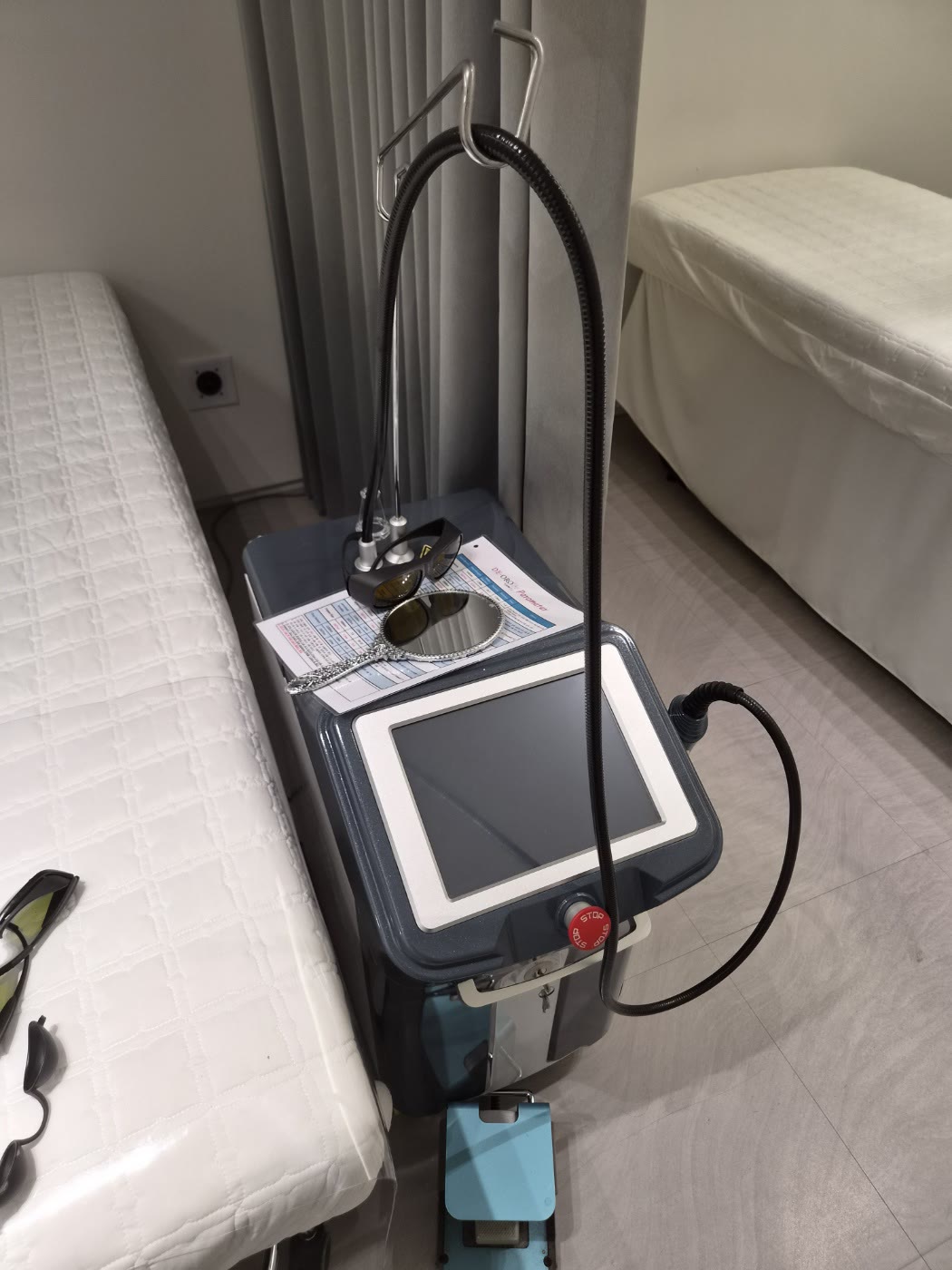
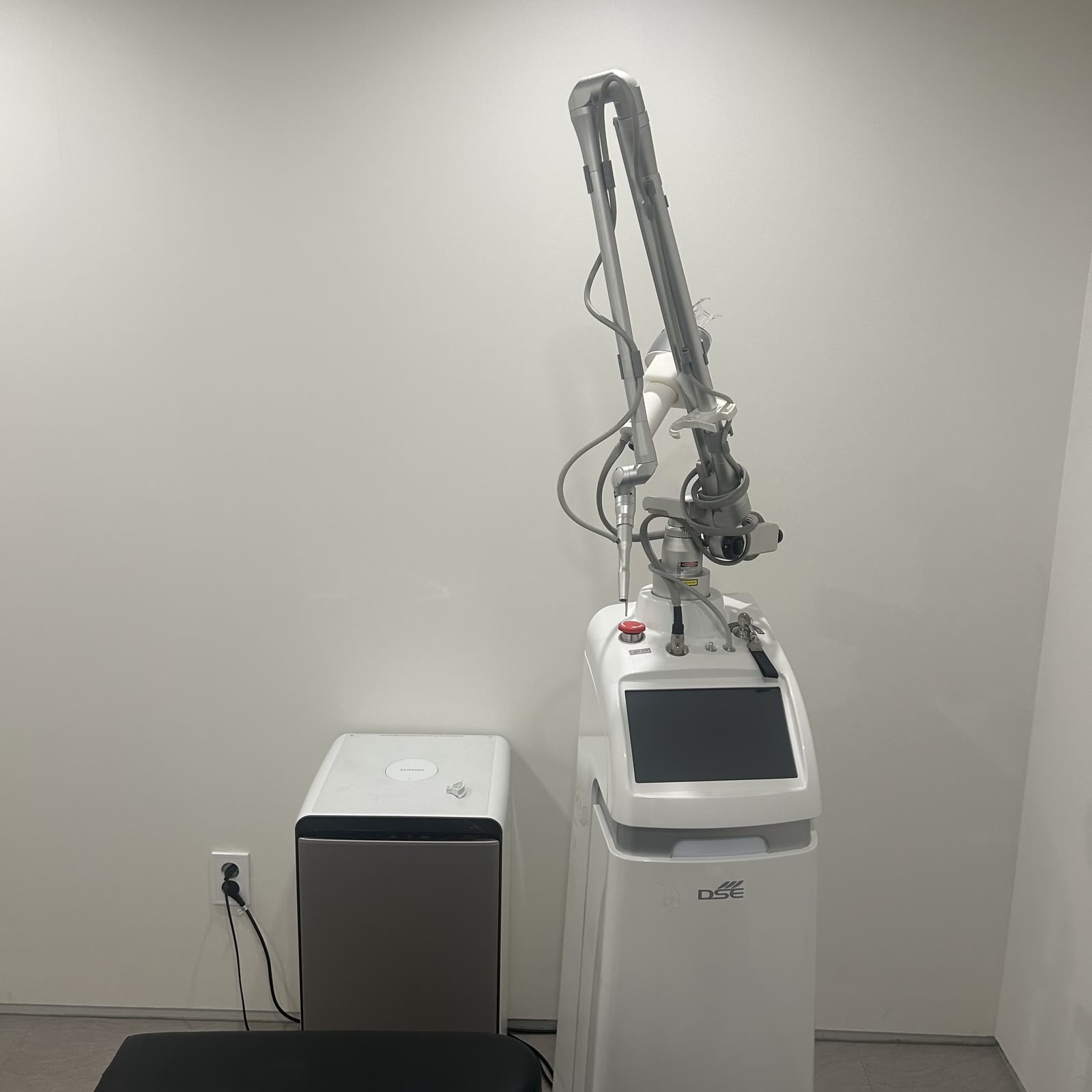
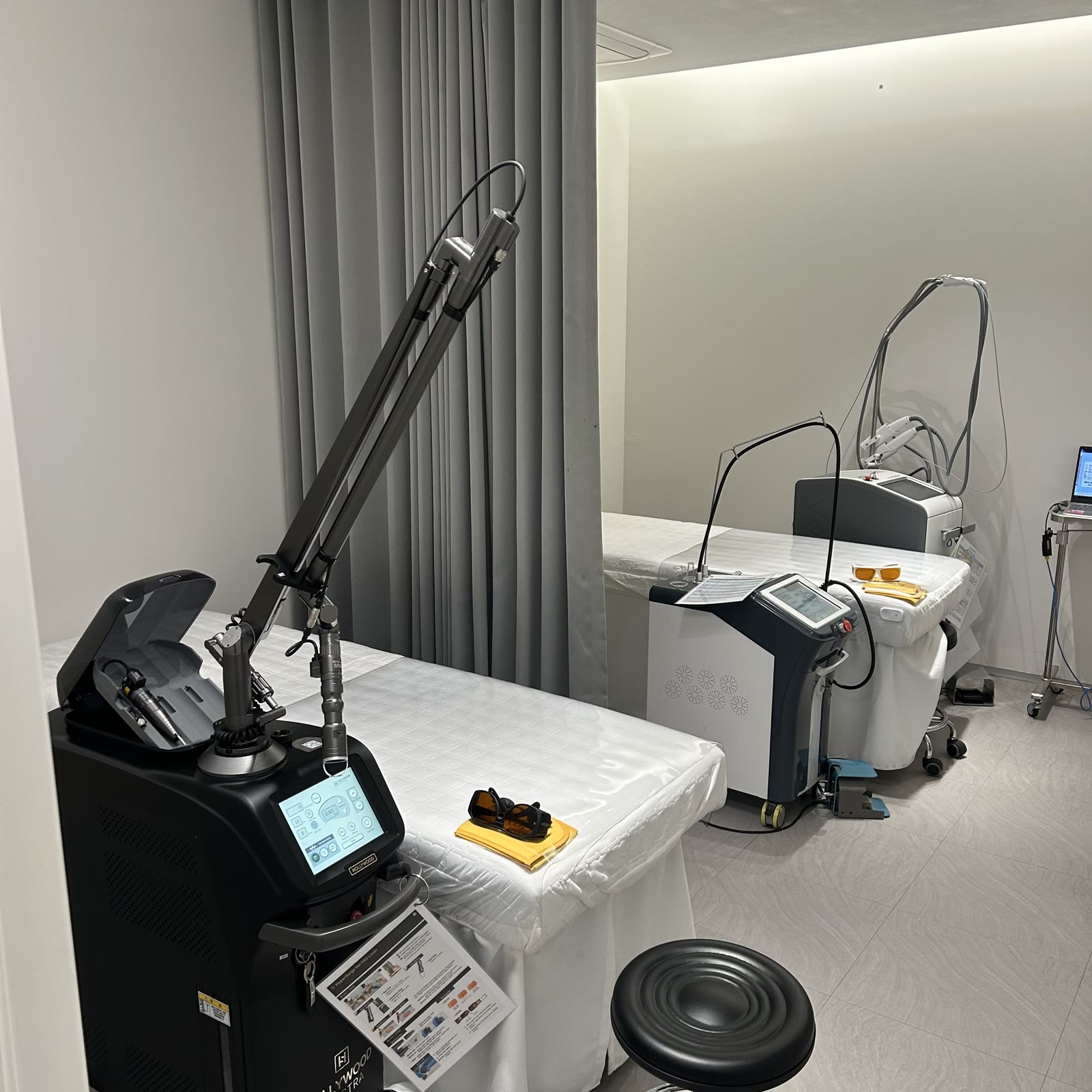
CO2 fractional uses thin laser beams to create tiny holes in the skin and deliver heat down to the dermis, triggering regeneration and collagen synthesis again in the scar area. Diore Dual uses two wavelengths, 1550 nm and 1927 nm, to create tiny columns of heat from the epidermis to the dermis, and Hollywood fractional delivers tiny thermal damage in a non-ablative way that does not peel away the skin surface. Potenza inserts fine needles to the desired depth and then emits radiofrequency heat from the needle tips to stimulate the dermis directly, and the depth can be adjusted to match the scars.
Rejuran S is a formulation with increased PN viscosity so that it stays longer in the scar area, and Juvelook works by having PDLLA gradually break down to support collagen production. For broadly sunken areas such as rolling scars, supporting the area from below with scar filler is also reviewed together during the consultation.
Treatment steps at our Suwon clinic
- Initial consultation and scar assessment
- Weekly Treatment Planning
- Sessions are performed approximately once a week
- Mid-course Review & Plan Adjustments
- Final Evaluation & Maintenance Guidance
The 5-week scar package is done for 30 minutes to 1 hour per session over a total of 5 weeks, and the recovery period depends on the treatment combination. The basic plan is Diore and Rejuran S in week 1, Potenza and Juvelook in week 2, Hollywood Spectra in week 3, CO2 fractional in week 4, and Diore Dual and salmon DNA injection (PDRN) in week 5, and the weekly plan is adjusted based on the diagnosis. When continuing with standalone treatments, the standard is 3–5 sessions of Potenza and Hollywood fractional at 4-week intervals, and at least 3–5 sessions of CO2 fractional at monthly intervals.
View 5-week scar package details
Recovery and care after acne scar treatment
- Right after treatment, tiny scabs, redness, and swelling may appear, and most recover within 3–7 days.
- Do not force the scabs off; let them fall off on their own.
- Consistently apply regenerating cream and moisturizer, and apply sunscreen when going out.
- For about a week after treatment, avoid irritants such as saunas, alcohol, peels, and scrubs.
Scar improvement goes through a process of collagen regeneration, so changes are monitored gradually over several weeks to months even after the course is completed. The deeper the depression, the more progress is seen as sessions accumulate rather than filling in all at once, and since new acne breakouts can leave scars again in those spots, acne care is continued as well.
Side effects and precautions for acne scar laser treatment
Common reactions are warmth, stinging, swelling, redness, dryness, and itching, which last from a few days to as long as a few weeks depending on the method. Bruising and bumpy marks may occur where injections were also given. The recovery period and degree of change vary depending on scar depth and skin, and from person to person.
In rare cases, post-inflammatory hyperpigmentation, worsening acne, or infection can occur. Darker skin tones or a lot of UV exposure during recovery increase the risk of pigmentation, and when inflammatory acne is active, the inflammation is calmed first before scar treatment. If you are taking any medication or your wounds tend to heal thick, please tell us before treatment. If you are pregnant or breastfeeding, taking isotretinoin, or prone to keloids, please let us know before treatment.
If pus comes out from under the scabs, swelling and pain get worse day by day, or blisters form, please contact the clinic right away.
What should be checked before acne scar treatment?
If any of these apply, start with a scar diagnosis
- Areas where acne has calmed down are depressed and can't be covered with makeup.
- When light shines from the side, wave-like undulations are visible on my cheeks.
- I have both narrow, deep, hole-like scars and broad scars.
- Red or brown marks also remain around the depressed scars.
If two or more apply, it is a good idea to check the scar type and depth and whether marks are also present before deciding on a laser. Whether to treat, which method to use, and the treatment area are decided together during the consultation after the doctor's examination.
In short, the key with acne scars is to first determine the type and depth, combine methods suited to each type week by week, and then allow time for collagen to fill in while monitoring progress.
FAQ
Q. Do acne scars go away on their own?
A. Red and brown marks may fade over time, but depressed scars where collagen has broken down are unlikely to fill in on their own. We recommend first checking the degree of depression, the scar type, and whether marks are also present.
Q. How can I tell what type my acne scars are?
A. If they are narrow and deep, they are close to ice pick; if they have angular edges and flat bottoms, boxcar; and if they are broad and gently wavy, rolling scars. Since they are often mixed on the same face, we check them under different lighting during the consultation.
Q. How many acne scar laser sessions do I need?
A. The standard is 3–5 sessions of Potenza and Hollywood fractional at 4-week intervals, and at least 3–5 sessions of CO2 fractional at monthly intervals. The actual number of sessions is decided based on scar depth and type and the response at each session.
Q. Can I get scar treatment while I still have acne breakouts?
A. If there is a lot of inflammatory acne, we tend to calm the inflammation first before starting scar treatment. Since new acne breakouts can leave scars again in those spots, the order of acne treatment and scar treatment is decided together during the consultation.
Q. When can I return to daily activities after acne scar treatment?
A. Right after treatment, tiny scabs, redness, and swelling may occur, and most recover within 3–7 days. The recovery period depends on the treatment combination, so if you have an important event coming up, let us know during the consultation and we will take it into account when planning the weekly schedule.
Q. How can I find out the cost of acne scar treatment?
A. The cost depends on the extent of the scars, the treatment combination, and the number of sessions. After diagnosing the type and depth of the scars, we explain during the consultation whether to go with a package or continue with standalone treatments, and you can also check the items for each package on our treatment information page.
This content is provided as general treatment information and is not a substitute for diagnosis or treatment. Always consult a medical professional to decide whether and how to proceed with a treatment.