


Acne Red Marks in Suwon: How Do You Tell Red Marks, Brown Marks, and Pitted Scars Apart?
If your acne has calmed down but red or brown marks linger and bother you, it is worth first checking whether the marks are only discoloration or pitted scars in the skin. Acne red marks look red because blood vessels that widened after inflammation remain, while brown marks are pigment left behind because inflammation stimulated melanin production; in both cases, the skin surface is flat.
Pitted scars are a condition in which collagen in the dermis has been damaged and the surface has sunk, so they are treated not with lasers that lighten color but with treatments that stimulate skin regeneration. At our Suwon clinic, we first look at the color of the marks, the depth of the pits, and how much acne is currently breaking out during consultation, and then decide which marks to treat first.
In this article, we go through why acne marks remain, how to tell red marks, brown marks, and pitted scars apart, lasers for each type of mark and the treatment steps, aftercare, and side effects.
Acne Red Marks: Key Points
- Red marks are caused by widened blood vessels, brown marks by remaining melanin, and pitted scars by damage to dermal collagen.
- If a mark fades briefly when pressed with a finger, it is likely a red mark; if the color stays the same, it is closer to a brown mark.
- Red marks are treated with wavelengths absorbed by blood vessels, brown marks with picosecond lasers that break up melanin, and pitted scars with regenerative treatments.
- If new acne keeps appearing, marks will form again, so acne control comes first.
Why do acne red marks and brown marks remain?
When acne inflammation occurs, the surrounding blood vessels dilate and new vessels grow, and melanocytes are also stimulated to produce more pigment. If the dilated vessels remain after the inflammation subsides, they become red marks, and if the increased pigment remains, it becomes brown marks. If the inflammation goes deep into the dermis and breaks down collagen, that spot cannot be filled in during healing, leaving a depressed scar.
Even with the same acne, there are conditions that make marks darker and longer-lasting. Squeezing acne by hand or picking at scabs, acne that repeatedly appears in the same spot, frequent sun exposure, and a naturally darker skin tone leave darker brown marks. Red marks last longer when the skin is thin and sensitive or when the skin barrier has been weakened by strong exfoliation.
How do you tell acne red marks, brown marks, and pitted scars apart?
Looking at your face from the front and the side under bright lighting lets you gauge the type of mark. The table below shows criteria you can check at home.
| Category | What it looks like | How to check | Main treatment approach |
|---|---|---|---|
| Red marks | A flat pink or reddish tint remains | Fades briefly when pressed with a finger and released, then turns red again | Lasers that reduce dilated blood vessels |
| Brown marks | A flat brown or grayish-brown tint remains | Color barely changes when pressed and darkens with sun exposure | Lasers that break melanin into fine particles |
| Depressed scars | The surface is sunken or uneven | Casts shadows when lit from the side, and the contour can be felt with a fingertip | Treatments that stimulate collagen regeneration |
On real faces, it is common for all three to be mixed. Shallow pits may be hidden beneath red marks, and brown marks may remain along the edges of scars, so we set the order starting with the most prominent mark.
Lasers for Acne Marks and Treatment Steps
How the laser used for each type of mark works
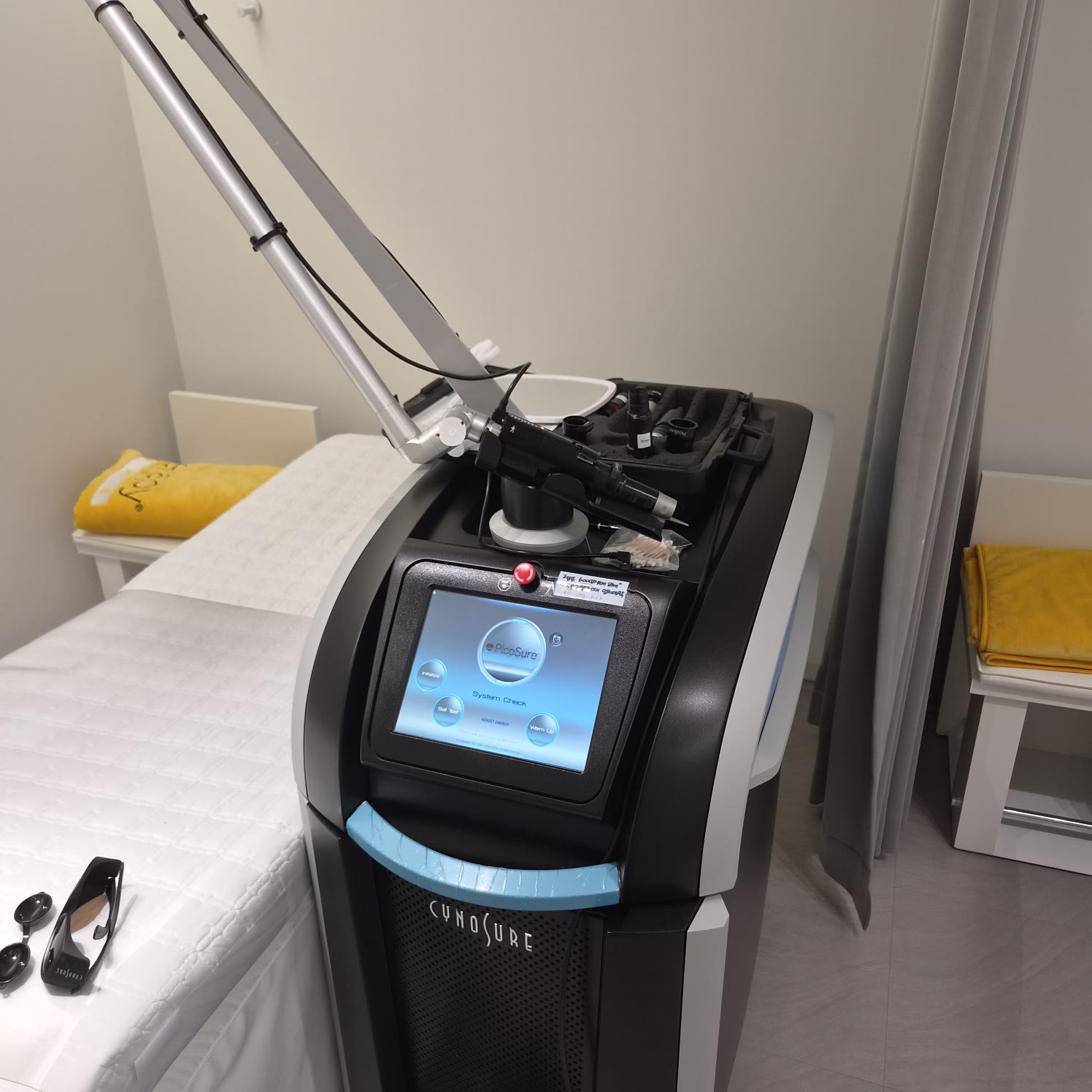
Red marks are treated with wavelengths absorbed by hemoglobin in blood vessels, aiming to reduce widened vessels. Excel V Plus targets red vessels and brown pigment with two wavelengths, 532nm and 1064nm. Brown marks are treated with PicoSure, a 755nm picosecond laser, which breaks melanin into very small fragments for the body to clear.
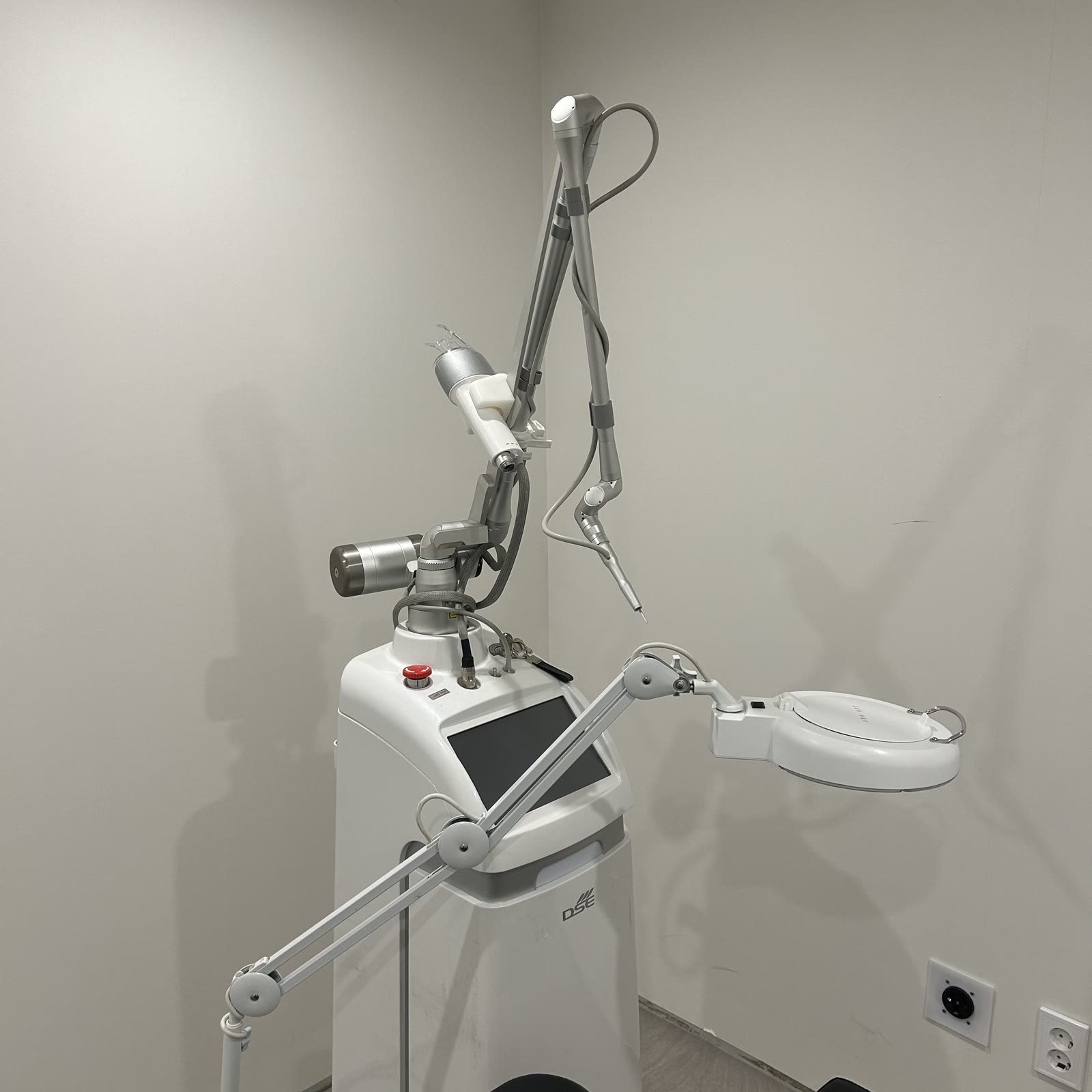
Pitted scars are a structural problem rather than a color problem, so we combine treatments to suit the shape of the scar: CO2 fractional laser, which makes tiny holes in the skin to stimulate dermal regeneration; Potenza, which delivers radiofrequency through microneedles; and injections that support regeneration. If new acne is still appearing, acne control comes before treating the marks.
Treatment steps at our Suwon clinic
- Personalized Consultation
- Self-Cleansing
- Treatment
- Finishing Care
Excel V Plus, used for red marks, takes about 10 minutes or less, and you can return to your daily routine right away; it is done 3 to 5 times at 3- to 4-week intervals. PicoSure toning, used for brown marks, follows the same steps and continues for 5 to 10 or more sessions at 1- to 2-week intervals. Depressed scars are treated with the 5-week scar package, which proceeds in this order: initial consultation and scar assessment, a week-by-week treatment plan, treatments about once a week, a mid-course progress check and adjustment of the plan, and a final evaluation with maintenance guidance; each session takes 30 minutes to 1 hour.
See Excel V Plus treatment details
View 5-week scar package details
Aftercare for acne mark laser treatment
- After Excel V Plus, wash your face gently with lukewarm water and apply repair cream and moisturizer often.
- After PicoSure toning, you can wash your face and wear makeup the same day, but for about a week avoid scrubs and peels and do not use retinol or brightening products.
- Do not pick off scabs that form after scar treatment, and avoid saunas, alcohol, peels, and scrubs for about a week.
- Whatever the treatment, apply sunscreen thoroughly whenever you go outside.
Flat red and brown marks can fade gradually over several months as the skin renews itself, so keep up sun protection, soothing care, and moisturizing during that time. Using high-concentration vitamin C or strong exfoliating products while redness remains can irritate the skin and make it last longer. Scar improvement goes through a collagen regeneration process, so changes are watched over several weeks to several months even after the course ends.
Side effects and precautions of acne mark laser treatment
After treating vascular lesions, the face may swell temporarily, usually settling within 1 to 2 days. Areas treated for pigment may look darker for a while, which usually settles within a few days, and after scar treatment, fine scabs, redness, and swelling may appear and mostly resolve within 3 to 7 days.
Rarely, blisters, hyperpigmentation, or loss of pigment can occur. These risks are higher on tanned skin, severely inflamed skin, or where scabs were picked off, so the timing and intensity of treatment are adjusted. Please tell us before treatment if you have recently tanned, are using retinol or exfoliating products, are taking medication that makes the skin sensitive such as isotretinoin, tend to form keloids, or are pregnant. How much and how quickly marks fade varies from person to person.
If blisters or oozing appear, or if pain and redness keep getting worse after several days, please contact the clinic right away.
What should be checked before acne mark laser treatment?
If any of these apply, start with an assessment of your marks
- Red or brown marks remain unchanged even 3 months after the acne has calmed down.
- I have brown marks whose color barely changes even when pressed with a finger.
- There are depressed spots that cast a shadow when light shines from the side.
- Acne keeps coming back in the same spot.
If two or more apply, it is best to first check whether the marks are a matter of color or of depression. Whether to treat, and the method and extent of treatment, are decided together in consultation after a doctor's examination.
In short, the key with acne marks is to first separate red marks, brown marks, and depressed scars, then decide the order of treatment for each type of mark while keeping new acne under control.
FAQ
Q. How many sessions of laser treatment are needed for red acne marks?
A. Excel V Plus, used for red marks, is done about 3 to 5 times at 3- to 4-week intervals. The number of sessions and the interval are adjusted based on how widespread the redness is, how sensitive the skin is, and the reaction after the previous session, and how much the marks fade varies from person to person.
Q. Will brown acne marks go away if left alone?
A. They can fade over several months as the skin renews itself, but they linger if you are often in the sun or acne keeps recurring in the same spot. If the color has barely changed after 3 months, laser treatment is considered.
Q. Can toning also treat depressed acne scars like pockmarks?
A. Toning targets pigment, so it cannot fill depressed areas. Depressed scars are treated by combining procedures that stimulate collagen regeneration, such as CO2 fractional laser or Potenza, according to the shape of the scar, and the number of sessions and the combination vary with scar depth.
Q. I still have acne. Can I treat the marks at the same time?
A. If new acne keeps appearing, marks will form again in those spots, so acne control comes first. Once the inflammation has calmed down, the remaining red and brown marks are treated, and the order in which to continue the two treatments is decided after examining your current skin.
Q. Can I wear makeup right after acne mark laser treatment?
A. With PicoSure toning, you can wash your face and wear makeup the same day; after Excel V Plus, wash gently with lukewarm water. For scar treatments, when you can wash and wear makeup depends on the week-by-week plan, so follow the instructions you receive after the treatment.
Q. How can I find out the cost of acne mark treatment?
A. The cost depends on the type of mark, the treatment combination, and the number of sessions. We will explain it after confirming in consultation which marks, among red marks, brown marks, and depressed scars, will be treated and in what order, and you can also check it on the treatment information page.
This content is provided as general treatment information and is not a substitute for diagnosis or treatment. Always consult a medical professional to decide whether and how to proceed with a treatment.